
News & events
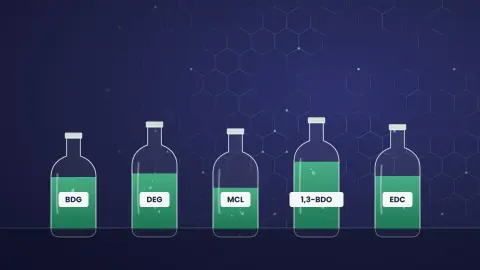
5 Solvents Every Formulator Should Know
Last updated on: October 18th, 2026
What these five workhorse chemicals are used for, how they differ, and how to buy them in drums, IBC or bulk from Rotterdam.
BDG, DEG, methylene chloride, 1,3-butanediol and EDC rarely make headlines, but they sit inside inks, coatings, cleaners, resins, cosmetics and pharmaceuticals. Buyers often search for them under different names or by CAS number, and the names are easy to mix up.
This guide explains what each one is, where it is used, which grades exist and how it is shipped. At the end you will find a quick comparison table and how to request a quote from Rotterdam Chemicals Group.
1. Butyl Diglycol (BDG)
Also known as: diethylene glycol monobutyl ether, butyl carbitol, butoxyethoxyethanol · CAS: 112-34-5
Grades: industrial grade (≥ 99%); high-purity grade on request · Packaging: 200 L drums, 1,000 L IBCs, road tankers and ISO tanks
BDG is a slow-evaporating glycol ether with a high boiling point (about 230 °C). It dissolves both water-based and solvent-based systems, which makes it a strong coupling agent and coalescent.
Typical uses
- Printing inks and screen-printing inks, where it slows drying and improves flow
- Water-based paints and coatings, as a coalescing agent
- Industrial and household cleaners, degreasers and hard-surface cleaners
- Textile and leather auxiliaries
Good to know: BDG is often confused with BDGA (butyl diglycol acetate), its acetate ester, and with DEG. Check the CAS number on your specification before ordering.
View BDG product page and request a quote →
2. Diethylene Glycol (DEG)
Also known as: 2,2'-oxydiethanol, diglycol · CAS: 111-46-6
Grade: industrial grade (≥ 99.5%) · Packaging: 200 L drums, 1,000 L IBCs, road tankers and ISO tanks
DEG is a clear, hygroscopic glycol made alongside MEG and TEG. It is a building block for resins and a humectant in many industrial products.
Typical uses
- Water-based coolants and heat-transfer fluids
- Polyester resins and plasticisers, as an intermediate
- Printing inks, to control viscosity and evaporation
- Industrial lubricants, hydraulic fluids and brake fluids
- Humectant and intermediate in various formulations
DEG vs BDG: both names contain "diethylene glycol", but DEG is the plain glycol while BDG is its butyl ether. They behave very differently, so always order by CAS number. DEG is an industrial chemical and is not suitable for food, pharmaceutical or consumer use unless a specific grade says so.
View DEG product page and request a quote →
3. Methylene Chloride (MCL / DCM)
Also known as: dichloromethane, DCM · CAS: 75-09-2
Grades: industrial grade (≥ 99.8%) and pharma grade (≥ 99.9%) · Packaging: 200 L drums, 1,000 L IBCs, road tankers and ISO tanks
Methylene chloride is a volatile, non-flammable chlorinated solvent (boiling point about 40 °C). It dissolves a wide range of organic compounds and evaporates quickly, which makes it valuable in extraction and synthesis.
Typical uses
- Pharmaceutical manufacturing: reaction and extraction solvent
- Chemical synthesis and laboratory work
- Polymer processing and foam production
- Industrial degreasing and metal cleaning
Good to know: in the EU, methylene chloride is restricted under REACH for consumer paint strippers and is intended for industrial and trained professional use. Always check the rules that apply to your application.
View methylene chloride product page and request a quote →
4. 1,3-Butanediol (1,3-BDO)
Also known as: 1,3-butylene glycol, butane-1,3-diol · CAS: 107-88-0
Grades: industrial grade (≥ 99%); cosmetic/pharma grade on request · Packaging: 200 L drums, 1,000 L IBCs, road tankers and ISO tanks
1,3-Butanediol is a mild, low-odour diol. It holds moisture well and dissolves many active ingredients, so it is widely used in personal care as well as in industry.
Typical uses
- Cosmetics and skin care: humectant, solvent and texture improver in creams, serums and toners
- Hair care and fragrance formulations
- Polyester and polyurethane resins, as a co-monomer
- Plasticisers and chemical intermediates
Good to know: 1,3-butanediol is a different product from 1,4-butanediol (CAS 110-63-4). For cosmetic applications, ask for a cosmetic-grade specification.
View 1,3-butanediol product page and request a quote →
5. Ethylene Dichloride (EDC)
Also known as: 1,2-dichloroethane · CAS: 107-06-2
Grade: industrial grade (≥ 99.5%) · Packaging: 200 L drums, 1,000 L IBCs, road tankers and ISO tanks
EDC is a chlorinated hydrocarbon best known as the starting material for vinyl chloride and PVC. In smaller volumes it serves as a solvent and intermediate.
Typical uses
- Chemical synthesis and intermediates
- Laboratory and analytical work
- Extraction solvent and process solvent in industry
Good to know: EDC is a hazardous substance under REACH and is supplied for industrial and professional use only. SDS, TDS and Certificate of Analysis are available on request.
View EDC product page and request a quote →
Quick comparison
- Butyl Diglycol (BDG) – CAS 112-34-5 · Glycol ether · Printing inks, coatings, cleaners
- Diethylene Glycol (DEG) – CAS 111-46-6 · Glycol · Resins, coolants, plasticisers
- Methylene Chloride (DCM) – CAS 75-09-2 · Chlorinated solvent · Pharma, chemical synthesis, degreasing
- 1,3-Butanediol – CAS 107-88-0 · Diol · Cosmetics, personal care, resins
- Ethylene Dichloride (EDC) – CAS 107-06-2 · Chlorinated hydrocarbon · Chemical synthesis, laboratories
Buy BDG, DEG, DCM, 1,3-BDO or EDC from Rotterdam
Rotterdam Chemicals Group has supplied chemicals and solvents to industry worldwide for more than 25 years. All five products in this guide are available from our Rotterdam base.
- Packaging: drums, IBCs or bulk
- Delivery: across Europe and worldwide from the Port of Rotterdam
- Documents: SDS, TDS and Certificate of Analysis available
Tell us the product, grade, quantity and delivery location, and we will send you a price.
Request a quote · sales@rotterdamchemicals.com · +31 (0)10 450 8722