
Nieuws & evenementen
Strait of Hormuz Reopening: What Could It Mean for Solvent Prices in Q3?

Strait of Hormuz Reopening: What Could It Mean for Solvent Prices in Q3?
Last updated on: June 24th, 2026
A possible reopening could ease pressure on energy, freight and feedstock costs, but the timing matters as much as the direction.
On June 18, the United States and Iran signed a memorandum of understanding ending the conflict that has effectively closed the Strait of Hormuz since early March. The deal has been signed, but the Strait is not yet open. The central shipping lane remains mined and cannot currently be navigated. An estimated 550 vessels are waiting to transit, while mine clearance operations are still in their early stages. Industry bodies expect shipping services to return to levels seen before the war within a couple of months, although the recovery in cargo volumes will probably take longer.
For chemical buyers, this is the moment the market has been waiting for. However, it represents the beginning of a recovery process rather than the end. This article explains what we expect for solvent and chemical feedstock prices in Q3 2026, based on current market conditions.
Why the Strait of Hormuz matters for chemical buyers
Roughly one quarter of global seaborne oil passes through the Strait of Hormuz each day. That figure alone explains why any disruption in the region immediately affects crude oil markets. For chemical buyers, however, the impact goes further.
Iran and Qatar together account for a significant share of global methanol and LNG production. Gulf producers are also major exporters of monoethylene glycol, aromatics and various petrochemical intermediates. The effective closure since early 2026 has removed an estimated 15 to 20% of the world’s petrochemical feedstocks from global markets. This temporarily reversed the oversupply that had been compressing chemical margins for years.
When the route closes, or when shipowners simply refuse to use it, European buyers face higher feedstock costs, elevated freight and insurance premiums, and delayed cargoes that reduce spot availability.
The disruption has also reshaped trade flows. Chinese imports into Europe decreased significantly as geopolitical tensions and duties on key chemical products restricted incoming volumes. European producers benefited, at least temporarily, from tighter supply and stronger margins. Those advantages are real, but they depend entirely on the disruption continuing.
A reopening would reverse those pressures. However, the timing and extent of the recovery will vary by product.
What a reopening does and does not mean for prices
Oil and energy markets tend to react quickly to geopolitical signals. Physical chemical prices do not. Commodity chemical prices already peaked in April 2026 and have been softening since then. They remain well above levels seen before the war, but the highest point has probably passed. A reopening would accelerate that decline rather than create it.
Before any price reduction reaches European buyers, Gulf producers need to restart inactive capacity, rebuild export inventories, secure vessels and complete voyages that normally take between two and four weeks from the loading port. Freight rates and war risk insurance premiums are also likely to remain elevated for some time after a reopening is announced. Shipowners will want to see sustained stability before adjusting their prices.
Recovery takes place in stages. During the first one to two weeks after reopening, the impact is mainly logistical. Tankers reposition, shipping schedules begin to normalise and spot freight may experience some immediate relief.
During weeks three to six, cracker restarts and gradual production increases become more important. Products derived from ethylene are likely to be among the first to respond.
By weeks seven to twelve, inventory rebuilding becomes the dominant market dynamic. Buying activity may actually increase during this period before prices fall substantially. Meaningful price normalisation, where buyers clearly benefit, usually becomes visible between months four and six.
There is also a structural limit to how far prices can fall. Once the Strait reopens, Asian chemical producers that have been constrained by the same feedstock shortages will also restart production. This will renew the competitive pressure on European markets that existed before the war.
European commodity producers are fully aware of this. Their margins will come under pressure again when Asian production and exports recover. This is ultimately positive for buyers, but the process will take time.
Buyers who assume that prices will collapse immediately are likely to be disappointed. A gradual easing of market pressure throughout Q3 and into Q4 is the more realistic base case. Prices are also unlikely to return fully to 2024 levels for at least several quarters.
Which products could become cheaper in Q3?
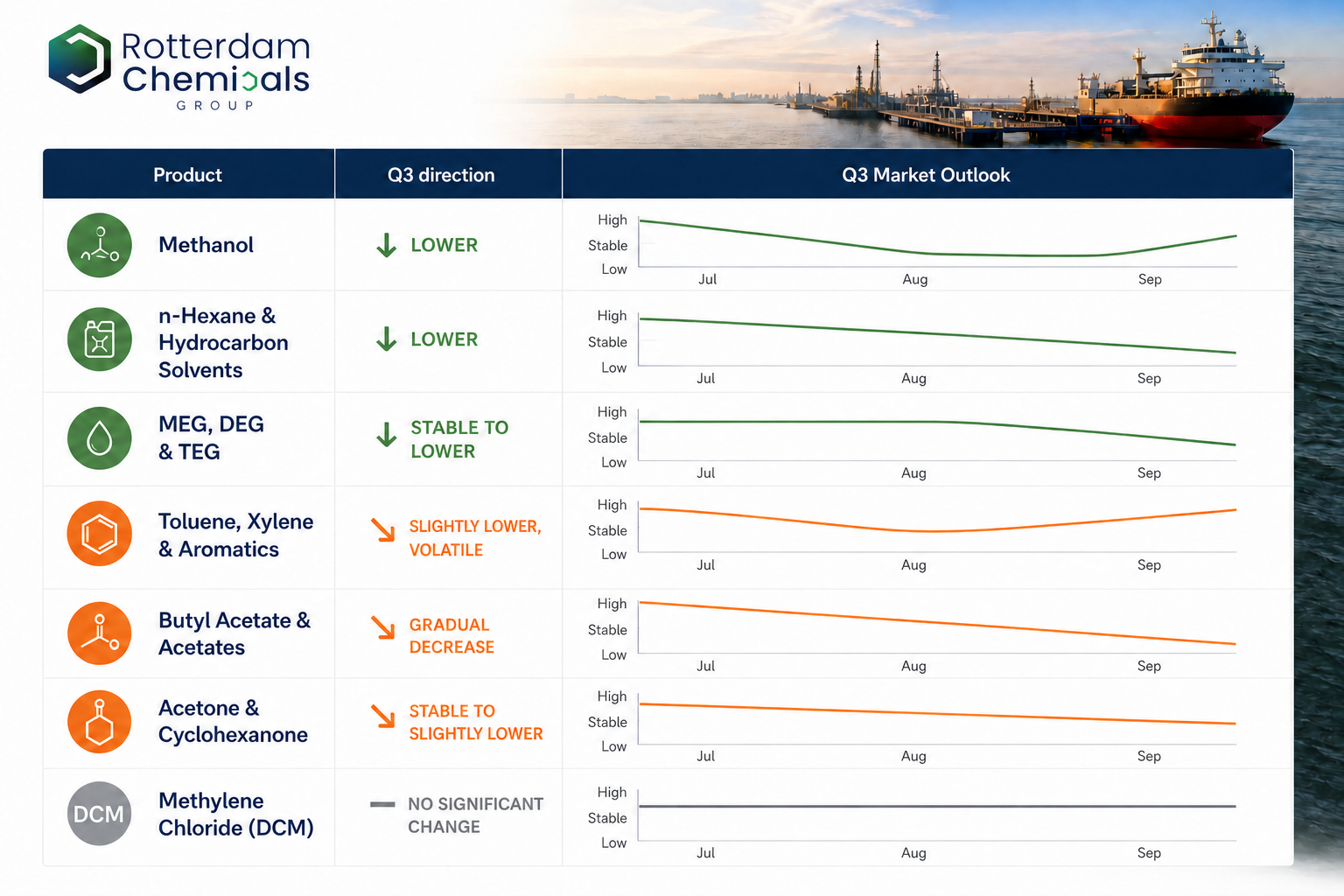
- Methanol: Lower
Iran and Qatar are among the world’s largest methanol producers. Restored export capacity would directly increase global availability and put downward pressure on European spot prices.
- MEG, DEG and TEG: Stable to lower
The Gulf is a critical production region for glycols. MEG is likely to react first because of its larger trade volumes. DEG and TEG should follow, although the timing will depend on individual plant output and available stock levels.
- Toluene, xylene and aromatics: Slightly lower but volatile
Lower naphtha and crude oil costs would reduce production costs. However, summer demand for gasoline blending continues to support aromatic prices, creating a mixed market picture.
- Normal hexane and hydrocarbon solvents: Lower
Products such as normal hexane, mixed hexanes, white spirits and the D40, D60, D70 and D80 grades should benefit from lower refinery operating costs and reduced freight risk premiums. These products have a relatively direct connection to crude oil input costs.
- Butyl acetate and other acetates: Gradual decrease
Acetate prices should ease if both alcohol and acetic acid feedstock chains soften. However, the effect will probably be slower and less pronounced than for methanol or hydrocarbon solvents.
- Acetone and cyclohexanone: Stable to slightly lower
Lower benzene and propylene input costs would provide support for lower prices. However, European production availability and regional demand will remain the main pricing factors for these products.
Which products are unlikely to react quickly?
Chlorinated solvents such as methylene chloride, perchloroethylene and trichloroethylene have little direct exposure to Gulf supply routes.
Their prices are primarily determined by European chlorine production economics, energy costs and the operational status of a small number of important plants. Unless the reopening also causes a broader reduction in European energy costs, these products are unlikely to experience meaningful price movement in Q3 as a direct result of the Strait reopening.
Our Q3 2026 base case
The most likely scenario is not a sharp price correction. Instead, we expect a gradual reduction in the supply pressures that kept chemical prices elevated during the first half of the year.
The clearest potential for price reductions in Q3 can be found in methanol, hydrocarbon solvents and glycols. Aromatics and acetates may follow after a slightly longer delay.
The pace of recovery will depend on how quickly shipping companies declare Gulf routes safe, how rapidly producers rebuild their stock positions and whether any secondary disruptions occur elsewhere.
Strongest potential for price reductions in Q3
- Methanol
- Hydrocarbon solvents, including normal hexane, white spirits and D grades
- MEG and selected glycols
- Aromatics, including toluene and xylene
- Acetates, including butyl acetate
Should buyers wait before purchasing?
This is the question we hear most often when lower prices are anticipated, and the answer is rarely straightforward.
Waiting can make sense when your stock levels are comfortable, your production schedule can absorb some delivery uncertainty and the required products are available from European suppliers with short lead times. In this situation, reserving part of your purchasing volume for potential Q3 spot opportunities may be a reasonable strategy.
Waiting makes less sense for products with limited European availability, long import lead times or contracts that are close to ending. For critical materials, covering part of your requirement now while leaving room for lower priced replacement volumes later is usually the more prudent approach.
It is also important to consider the inventory rebuilding phase that normally follows a major disruption. This phase can temporarily increase purchasing volumes and prices before the market stabilises. Companies that already have supply agreements in place are usually better positioned than companies that must compete for spot cargoes.
|
Factor to consider |
Implication |
|
Current stock level |
Low stock creates a higher risk when waiting |
|
Product availability in Europe |
Tight European supply limits spot options even when prices decline |
|
Import lead times |
Gulf cargoes normally take three to five weeks to arrive in Rotterdam |
|
Production criticality |
Critical materials may justify partial purchasing coverage now |
|
Q3 replacement cost |
Compare the potential saving with the delivery risk before deciding |
A stable reopening of the Strait of Hormuz would create a more favourable purchasing environment in Q3. However, a more favourable environment does not necessarily mean significantly cheaper products. Buyers who plan carefully and act on confirmed market signals rather than rumours will be in the strongest position.
Conclusion
If the Strait of Hormuz reopens and shipping returns to normal, the chemical market should experience a gradual easing of the supply pressure and cost inflation that characterised the first half of 2026.
Methanol, glycols, hydrocarbon solvents and aromatics have the clearest potential to soften in Q3. Chlorinated solvents and products with predominantly European supply chains will be less directly affected.
The critical word is gradual. Physical chemical prices follow physical supply chains, and those supply chains need time to adjust. Recovery happens in stages. Logistics recover first, followed by production and then inventory. Price normalisation usually follows all three stages.
Buyers who plan their purchasing around this reality, rather than expecting prices to collapse overnight, will be better equipped to navigate Q3. It is also important to recognise that prices are unlikely to return fully to levels seen before the war. Too much has changed in the supply and trade landscape for that to happen quickly.
For European buyers, this is a good moment to review purchasing plans, secure supply where necessary and remain flexible for possible price opportunities later in Q3.
Rotterdam Chemicals Group supplies a wide range of solvents and chemical raw materials from European and international sources. We help customers compare available origins, lead times, packaging options and market prices to find the most suitable supply solution.
For current availability, pricing or advice on a specific product, please contact our sales team.